And the key to getting an agent to request a full.

I threw myself into the querying flames without doing the proper research first.
With some sort of ridiculous confidence or idiocracy—you could argue either, to be honest—I sent out a handful of queries in August 2019, shortly before being accepted to the Avengers of Colour mentorship. These queries, as much as I would like to repress them, were not my best work by any means. I found the agents I submitted to on Twitter through call outs for specific wishlist items my manuscript seemed to fit.
One person in particular had put out a call for more Latinx fantasies in their inbox. In my excitement-induced haste, I sent off my query without checking their agency or affiliation. Big mistake. Huge. It turns out they were an editor at a major publisher and me, an absolute newbie to the world of publishing, had just ended my career before it began.
Or at least I thought I did.
The editor I emailed was kind enough to explain the difference and encourage me to keep trying. It was a simple gesture, but in the publishing world, I am quickly learning, no one owes you an email. Or an explanation for that matter.
It’s that silence — that endless, painful silence — that acts as the defining characteristic of cold querying. Days, weeks, even months waiting, hoping, wishing that an agent will read your query and request a partial. Or, if you’re really lucky, a full. Then, of course, the ultimate response: an offer or a rejection.
The worst part about a rejection, especially on a partial or a full, is that there’s often a form response that comes with it. Something along the lines of “I’m only taking on projects I’m truly passionate about” or “I didn’t connect as much as I would have hoped.” Given the sheer amount of queries an agent has to sort through, on top of their additional duties to their clients, it’s no surprise that agents typically use templates when rejecting someone. Hell, it probably sucks for them to send a ‘no’ as much as it sucks for us to receive one. In the end, querying is about finding the right champion for your work and a ‘no’ is merely the wrong agent stepping aside for the right one.
Still, it’s that ‘no’ that can linger in your brain endlessly. And it did for me. With little research done on the decorum of querying, I would often email agents if they had any feedback for me and, to my surprise, a few responded. Again, they didn’t owe me an explanation, but it meant the world to me that they took the time to provide feedback to me despite their busy schedules. And I’d go on to use their feedback in later drafts of my novel, because if multiple people are telling you the same thing, it’s clearly something you should listen to.
What is cold querying?
Cold querying is sending out a query to an agent with whom you have no connection. There’s no #SFF or #LatinxPitch you can use to make an introduction. There’s no friend-of-a-friend who can introduce you. It’s just you putting your query out into the ether and hoping for a response.
I highly recommend participating in Twitter pitch contests to at least try to get an ‘in’ with an agent as opposed to straight cold querying. But, that doesn’t mean you won’t have cold querying success. The agent I ultimately ended up choosing was a cold query!
What is a good cold querying request rate?
While some say your query should be getting you a 20% response rate, the number is probably closer to 10%, especially if you haven’t tweaked your query letter to the agent’s MSWL. It’s important to remember not to compare yourself to others. In the end, request rates really only tell you if your query is working, not how worthy your story is of representation. Plus, everyone’s journey looks different. Some people query for years while others have offers overnight.
What’s the secret to a successful cold query?
As much as I wish there was some secret formula that would bring every single one of you endless manuscript requests, the truth is, there’s no one-size-fits-all secret to cold querying. But there is such a thing as having a good cold querying strategy.
Before you start querying, pick two or three agents you admire and send them your query. It might take a few weeks before you hear anything back, but this is where patience comes into play. By selecting a small group of test subjects, you can make sure your cold query is working for you before you mass submit to more agents. I’d recommend saving your dream agent query for after you’ve done this test, because you really only have one shot to impress them.
Follow Marilyn on Twitter, Instagram, and TikTok
Once you hear back from your group of test subjects, you’ll know whether or not your query is working. If you got more rejections or non-responses, you might need to tweak your query to make it more enticing. Perhaps use the first line of your query to personalize why you chose to query that agent. Was it something on their #MSWL that your book has? Are you a fan of one of their clients? Small details like this could go a long way.
More importantly, it’s vital to have a short, one-page query and a clear, one-page synopsis that highlight exactly what makes your book so special. Agents don’t need to know every single problem your protagonist will face, or whether or not your main character loves fancy European cheese. While these might add plenty of personality to your manuscript as a whole, you’re selling a story. Think of your query and synopsis as the short blurb on the back of the book and a more in-depth overview that you’d find on the inside flap. Then, ask yourself: Would I buy this book? Would I pick this book up off the shelf and willingly spend $20 on it?
If the answer is no, you need to commercialize your query a bit more. Agents need to be able to visualize your story and understand how they can sell it. After all, you might have a fantastic story on your hands, but if your query isn’t giving the agent a good idea of the market for this book, then odds are they might pass.
How to write a successful cold query?
Your query package is the first introduction an agent has to your writing. The first ten pages (arguably your entire first chapter) is going to tell an agent if you write in a style that they like. Reading is a subjective hobby and not everyone has the same taste as you. It doesn’t necessarily mean your writing is bad, it just means that particular agent isn’t quite a good fit for you. And there’s nothing wrong with that. Again, they are stepping aside so the right agent can find you.
But, before an agent gets to your pages, they’re reading your query letter. A brief, one-page overview that will most-likely make or break your chances at a full request. I find writing a query letter to be the easiest part of a query, especially if you stick to a specific formula:
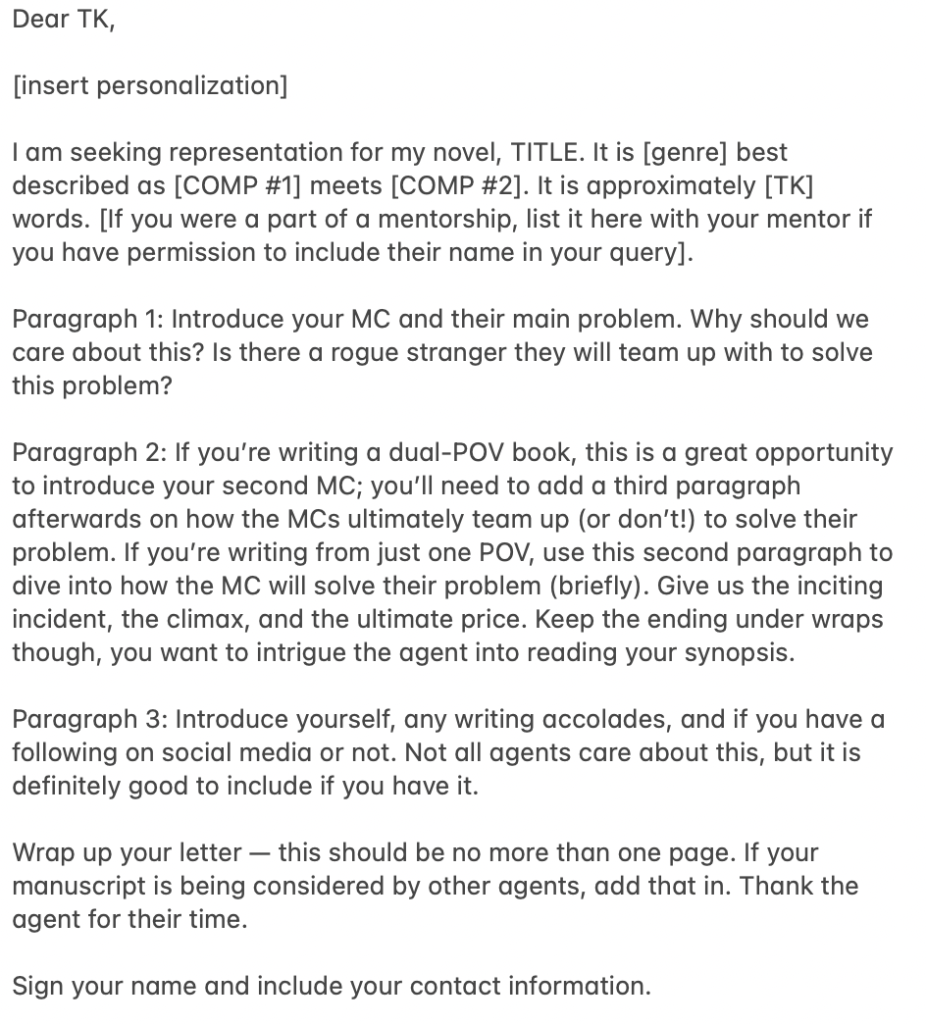
The synopsis is just an expansion of your query letter, with the exception that you will ruin your ending for the agent. They need to know the main plot points, including the grand finale to know whether or not they want to request more materials from you. This is a great place to include whether or not your novel is a standalone or written with series potential.
My advice to you is: Apply to mentorships, reach out to fellow #amquerying Twitter users, and apply to as many critique giveaways as possible. Authors will often give them away when they hit follower milestones (I recently gave one away, so keep your eyes peeled for another!). Getting someone else’s opinion on your query will help make sure your cold query is engaging and in the best possible position to get a full request. That’s the goal, after all.
Have questions about querying, finding an agent, or writing a book? Leave a comment or tweet at Marilyn.
Read more: How I Got My Agent
 Marilyn La Jeunesse